By ERRASONVET · Updated 6 October 2026
Compare portable milking equipment by the intended animal, container or receiver capacity, power supply and the components included. This guide separates two compact cow machines, two mobile unit configurations and a portable cow milking parlour. Their specifications describe different equipment packages; a larger container or higher motor power is not a demonstrated milking-speed advantage.
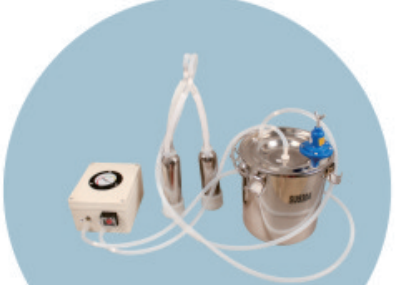
Compact cow machines: 6 L and 12 L containers
| Product | Container capacity | Animal | Working voltage | Power | Battery specification |
|---|---|---|---|---|---|
| 6 L Compact Cow Milking Machine ERV-DF-SYS-00003 |
6 L | Cow | 12 V | 20 W | 12 V; 12000 mAh |
| 12 L Compact Cow Milking Machine ERV-DF-SYS-00005 |
12 L | Cow | 12 V | 20 W | 12 V; 12000 mAh |
Both compact cow models list an adjustable working vacuum of 0.04–0.05 MPa and a pulsation rate of 60 per minute. These are listed product parameters, not operating advice for a particular animal or installation. Confirm the supplied equipment instructions and configuration.
The two models share a listed 12 V, 20 W specification and a 12 V, 12000 mAh battery specification. Their container capacities differ. The battery entry does not establish actual runtime, charging time or the number of animals that can be milked on one charge.
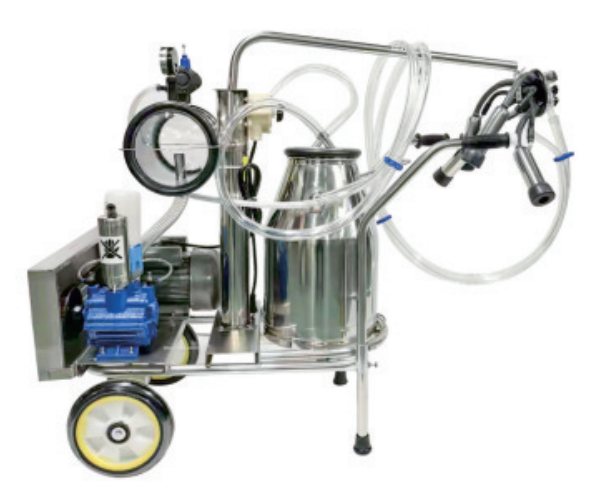
Mobile machines: one or two milking units
| Product | Milking units | Voltage and frequency | Power |
|---|---|---|---|
| Single-Unit Mobile Milking Machine 1.1 kW ERV-DF-SYS-00006 |
1 | 220 V / 50 Hz | 1.1 kW |
| Two-Unit Mobile Milking Machine 1.1 kW ERV-DF-SYS-00007 |
2 | 220 V / 50 Hz | 1.1 kW |
The single-unit and two-unit mobile models both list 220 V / 50 Hz and 1.1 kW. Their unit counts differ. These entries do not establish the container size, an animals-per-hour figure or the animal-specific cluster supplied. Confirm those points and the complete component list when requesting a quote.
Portable cow milking parlour: a separate equipment package
Portable Cow Milking Parlor 2.2 kW
ERV-DF-PAR-00032
| Product | Animal | Voltage and frequency | Power | Milk receiver capacity | Washing system |
|---|---|---|---|---|---|
| Portable Cow Milking Parlor 2.2 kW ERV-DF-PAR-00032 |
Cow | 380 V / 50 Hz | 2.2 kW | 40 L | Jetter tray and washing tank |
This model lists a 16 × 26 mm PVC milk tube, an 8 × 14 mm PVC twin pulse tube and rubber liners. It also lists a vacuum degree of 0.04–0.05 MPa and a pulsation ratio of 60:40. The receiver’s 40 L capacity is distinct from the compact machines’ container capacities. Confirm the number of supplied milking units, installation dimensions, connection requirements and itemised equipment scope.
Choose the equipment format before comparing capacity
- Compact cow machine enquiry: choose the 6 L or 12 L container reference and confirm the supplied battery, charger, cluster and accessories.
- Mobile machine enquiry: identify one or two milking units, confirm the animal-specific assembly and request the container and component details.
- Portable parlour enquiry: confirm site electrical supply and layout, the 40 L receiver configuration and the listed washing equipment.
Keep the electrical values model-specific: 12 V for the selected compact machines, 220 V / 50 Hz for the selected mobile machines, and 380 V / 50 Hz for the listed portable parlour. These specifications do not establish electrical phase, plug type or compatibility with a site’s power supply.
Prepare a complete equipment quotation request
- State the ERRASONVET product code, required quantity, intended animal and intended equipment use.
- Describe the available electrical supply and whether battery operation is required. Ask for confirmation of chargers, plugs and other supplied electrical parts.
- Specify the desired container or receiver capacity and the required number of milking units as separate requirements.
- Request an itemised list of liners, shells, claws, tubes, containers, receiver, pump and washing components as applicable.
- Provide site or transport dimensions, mounting constraints and connection photographs where equipment will join an existing system.
- Request the instructions and model-specific spare-parts list, plus packaging details and destination-specific quotation information.
Frequently asked purchasing questions
Does a 12 L machine milk twice as fast as a 6 L machine?
No such performance comparison is established. The listed difference is container capacity; the reviewed entries do not provide comparative milking times.
Does 12000 mAh tell me the operating time?
No operating-time claim is established by the listed battery specification. Ask for documented runtime and charging details for the exact supplied configuration.
Are replacement clusters or pumps universally interchangeable?
No. Confirm the existing system, component drawings and connection requirements. The component guides linked below help collect enquiry details, but do not establish interchangeability between complete machines.
Request a portable milking equipment quotation
Send the product code, container or receiver preference, intended animal, required unit count, electrical supply and destination. Include any uncertain component or installation details so they can be resolved in the quotation.
Request a dairy equipment quotation